He learned to swim at 41. He still remembers what the fear feels like.

A book for adults who never learned — written by a father who started from zero and earned his German swimming badges bronze, silver, and gold in under two years.

Get the book

EPUB + PDF · instant download · cards, PayPal

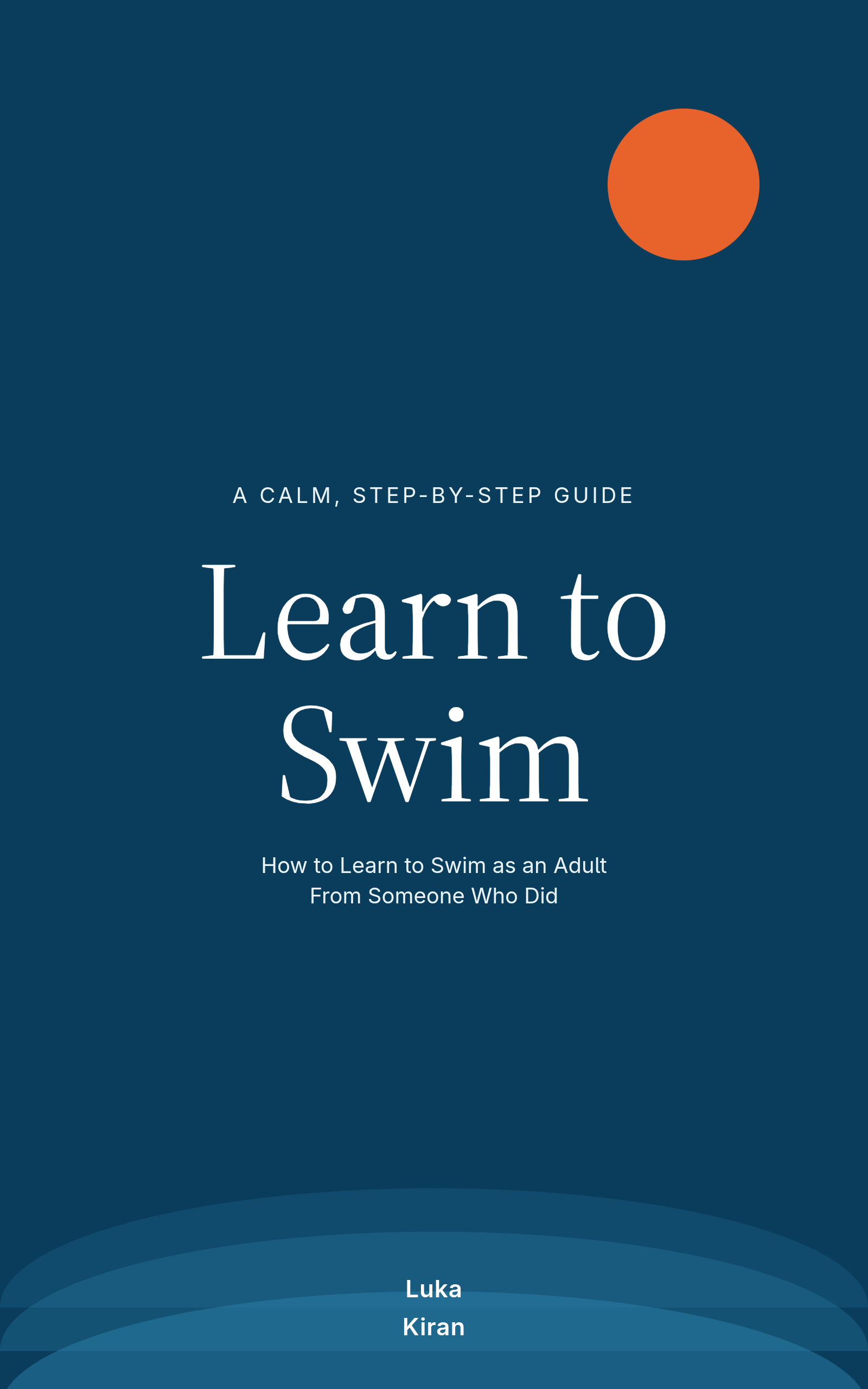
Book cover: Learn to Swim

You are not alone in this.

You know it in your bones: if you do nothing in the water, you sink. Your body is not built for floating. Swimming is something other people do — people who learned as kids, whose muscles somehow know what to do. You have to fight the water just to stay at the surface — and that fight could end the moment you stop.

And everyone can see it. Every trip to the pool, you’re sure the lifeguard has already picked you out. The other swimmers glide past, and you’re certain they are watching — or worse, laughing inside. You keep to the shallow end, gripping the wall, feeling like the only adult in the building who doesn’t belong here.

You have probably never told anyone this. Not your closest friends. Not your partner. It’s a secret you carry into every pool, onto every beach, through every summer. It has been there so long it feels like part of who you are.

If you have children, there is another layer. The bench. Sitting on the sidelines while someone else takes your kids into the water. Watching them splash and jump and trust the water in a way you never have. The guilt of not being the one in there with them — of not being able to show them that it’s possible. You promised yourself you’d fix this before they were old enough to notice. And now they’re old enough.

You’ve tried. Of course you’ve tried. Maybe it was a group lesson where the instructor breezed past putting your face in the water and moved straight to kicking drills before you were ready. Maybe it was a YouTube series — an athlete in a competition pool demonstrating perfect strokes, as if the gap between you and them was just a matter of technique. Or maybe it was the well-meaning friend who said, “Just relax — the water holds you up.” They meant well. But they learned to swim before they learned to ride a bike. They have no idea what your body feels like when it touches water.

Here is the thing every one of those teachers had in common: they learned to swim as a child. Every single one. They cannot remember what it is like to be afraid of water, because the memory was never formed. They’re not lying to you — they genuinely do not know the fear you are carrying. They can’t teach what they never experienced.

The author of this book does remember. He was forty-one years old — a father with two daughters — when he walked into the shallow end for the first time and started from zero. He had the same fear. The same certainty that his body would sink. The same forty years of silence.

So who is he?

He was forty-one. He was afraid. He learned anyway.

My name is Luka Kiran. I am a father of two daughters. I live in Germany. And until I was forty-one years old, I could not swim.

I am not talking about “wasn’t very good at it” or “hadn’t been in a pool for a while.” I am talking about never having learned. Forty years of avoiding water, afraid of it, silent about it. I did not grow up near a pool. My parents could not swim either. Swimming was not discussed, not present, not something our family did. My school swimming lessons did not teach me to swim — they taught me that water was not for me. At the end of the year, my report card said, flatly: “Luka Kiran could improve his swimming.” That was the intervention. The system shrugged. So did I.

For decades I developed the silent strategies every adult who cannot swim knows by heart. I changed the subject when swimming came up. I sat fully dressed beside a hotel pool while everyone else swam. I asked to move away from a calm riverbank because the water felt too close. I never told anyone why — not friends, not partners, not my wife before she became my wife. The fear had no language because I had never once spoken it out loud.

Then I became a father. And something shifted.

My oldest daughter started her first swimming course. I was not there — not in the water, not at the poolside, not anywhere she could see me. I was the father who had to be told about it afterward. I could not follow her into the water. If anything went wrong, I could not help. That knowledge sat in my stomach like something heavy and permanent. I did not want my daughters to grow up with a father who was absent from one of the most fundamental experiences of childhood. I made a decision. The fear could come along. It was not allowed to drive.

I tried. And I failed. I walked into a trial lesson at a public pool. I was moved too fast into water I was not ready for. Afterward, I lied to the organizers on the phone — told them I already had another course — and I quit. That story is in the book. It was humiliating. It was also the proof that the failure was not in me. The approach was wrong.

Then I found a proper adult course. At forty-one, I walked into the shallow end and started from zero.

What followed, I did not expect.

In Germany, swimming proficiency is measured by a system of badges. The first is the Seepferdchen — a child’s badge. I earned mine in May, at forty-one. Six months later, in November, I earned the Bronze badge: 200 meters in 15 minutes, a deep dive, a jump from the 1-meter board. The Silver badge followed in March of the next year: 400 meters, two deep dives, a jump from 3 meters. And the Gold badge — 800 meters, 50 meters of breaststroke under 1:15, transport swimming, three deep dives in three minutes — I earned in September of the same year. Seventeen months from the lowest rung to the highest.

I am not athletic. I am not gifted. I am stubborn. That was enough.

I wrote this book because the book I needed — the one that spoke to the fear, not just the technique — did not exist. Every other resource assumed you already felt safe in the water. I did not, and I remembered every detail of what that felt like. This is the book I wish someone had handed me the day I decided to try.

In the next section, you will see what is inside it.

A ladder, not a lecture.

Most swimming books fall into one of two traps. They are either vague motivation — “you can do this, just believe!” — written for people who already feel safe in the water. Or they are stroke-technique manuals written by coaches who learned to swim before they learned to read. Neither was written for you.

This book is neither.

It is a ladder. Ten chapters, each one a single step. Each step ends with one concrete assignment you can take to the pool — or, for the first one, to your kitchen — and actually do. No theory that stays on the page. No drills that assume you already know how to float. Just the next thing, clearly explained, by someone who was afraid of it too.

Your kitchen sink. Before you ever set foot in a pool, you fill a sink with water, put your face in, and exhale through your nose. That is the whole assignment. No audience. No lifeguard. Nobody watching. For an adult who has spent decades avoiding exactly this sensation, that single exhale is the first proof that the water does not win by default.

Standing and breathing. Now you are in the shallow end, feet on the floor, water at your waist. You learn to breathe — not the way swimmers breathe during laps, but the way a person breathes when they are learning to trust the water. Face in, exhale. Face up, inhale. You repeat it until your body stops bracing for disaster every time the water touches your chin.

Floating. This is the one that sounds impossible. It is also the one that changes everything. You learn that the water holds you — not because someone told you, but because you feel it. You lie back, let go of the wall, and something happens that your instincts have been arguing against for years: you do not sink.

Moving. Once you trust the water to hold you, you can move through it. A few meters on your back. Then a few more. You discover that propulsion is not about strength. It is about shape — letting the water carry you forward instead of fighting to stay afloat.

Jumping in. By the time you reach this chapter, you are no longer the person who walked into the pool. You step to the edge and you jump — from the poolside, into water where you can stand. You come up grinning. It is the grin that matters.

Every chapter follows the same shape. The author’s own moment at that step — what he felt, what went wrong, what finally worked. One skill, broken down so a human being can actually do it. One assignment. That is the rhythm of the book: story, skill, do.

What this book will not do

This book will get you practicing in the water. It will get you into an adult swimming course with confidence — not as the person who hangs back, but as someone who has already put their face in the water and knows what comes next. It gives you the ground you need to build on.

It will not teach you competitive strokes. It is not a butterfly or backstroke manual. It is not for children, and it is not for people who already know how to swim and want to refine their form. If that is what you are looking for, this is the wrong book — and it is better to know that now.

Every water exercise in these pages follows one rule: stay in the shallow end, stay where a lifeguard can see you, and never do anything that does not feel safe to you. Fear is not the enemy here. Pushing past it recklessly is.

Ready to see what you get? The next section has the details.

Get your copy

€11.99

EPUB + PDF · DRM‑free · instant download
Read on any device — phone, tablet, e‑reader, or laptop.

Buy the ebook — €11.99

Credit card · PayPal · Wero · Alipay · WeChat Pay · secure checkout by Mollie

Prefer a Kindle or paperback? Also available on Amazon.

Problems with payment or your download? Write us at info@learntoswim.com — we’ll sort it out.

Questions you might have

“Am I too old for this?”

No. The author learned at forty-one — and he is not the oldest person in this book. The final chapter tells the story of a woman who arrives at the pool with a rollator, lowers herself into the water one step at a time, and floats on her back, eyes closed, at peace. She does not swim laps. She does not train. She simply receives what the water offers.

Age is not an obstacle in this book. It is the premise. Every exercise, every example, every page assumes you are an adult starting from zero — not a child who bounces back from a bad experience, not a teenager with nothing to unlearn. If you have spent thirty or forty or fifty years believing the water is not for you, this book was written for you.

“I’m not just unable to swim — I’m afraid of water. Can a book really help?”

The fear is the book’s actual subject. It does not treat fear as something to push past or ignore. It treats fear as the central problem — the thing that has to be understood before anything else can happen.

Here is what a book can do: it can give you an honest, accurate understanding of why your body reacts the way it does to water. It can give you a sequence of exercises that start so small — your kitchen sink, on your own, nobody watching — that fear does not get a vote. It can let you work through the rationale before you ever get wet, so that when you do step into a pool, you already know what is happening and why. It can convince you, chapter by chapter, that you are not broken and the water is not your enemy.

Here is what a book cannot do: it cannot be a substitute for water. At some point, you have to get in. The book’s job is to get you to that point — and then to get you into a real course with an instructor who can see you, correct you, and keep you safe. Think of it as the bridge between where you are now and the pool deck. You cross it at your own pace. But you do not have to cross it alone.

“Do I need a pool to start?”

No. The first practice exercise starts at your kitchen sink.

You fill it with water, put your face in, and exhale through your nose. That is the entire assignment. No pool. No lifeguard. No audience. Just you, a sink, and the discovery that you can control what happens when your face meets water — on your own terms, in your own kitchen, with a towel right there if you need it.

The pool comes later, when you are ready. The book tells you exactly when and how.

“Is this for my kids?”

No. This book is for adults. The exercises assume an adult body, an adult history, and an adult’s relationship with fear. A child who cannot swim has a different experience than you do — and this book does not try to serve both.

That said, being an example for your children is one of the book’s quiet themes. The author learned because he could not bear the thought of his daughters growing up without a father who could get in the water with them. If that thought sounds familiar, you are in the right place. But the book itself is for you, not for them.

“Will it teach me proper strokes? Crawl? Breaststroke?”

No. This book will not teach you competitive strokes. It will get you from fear to floating, from floating to moving through the water, and from moving to course-ready — confident enough to walk into an adult swimming class and know you belong there.

Once you have that foundation, technique books become genuinely useful. The book recommends Total Immersion as a natural next step — but only after the comfort this book builds is fully in place. Not before. If you try to layer stroke technique on top of fear, the fear wins every time. This book removes the fear first. Then the technique can take.

“What formats? Can I read it on my phone?”

You get two formats with your purchase: EPUB and PDF. Both are DRM-free — no restrictions, no license that expires, no app required. Read them on your phone, your tablet, your e-reader, or your laptop. The EPUB adapts to any screen size. The PDF preserves the layout exactly as designed.

Prefer a Kindle or a physical paperback? Both are available on Amazon.

“Something went wrong with my payment or download.”

Write us at info@learntoswim.com. A human being reads every message, and we will sort it out — usually within a few hours. If your payment went through but the download link did not arrive, include the email address you used at checkout. If the file will not open on your device, tell us what device and what happens when you try. We will make it right.